
🚨 AI Just Changed the Cybersecurity Game — And PHP2Shell Is a Wake-Up Call!
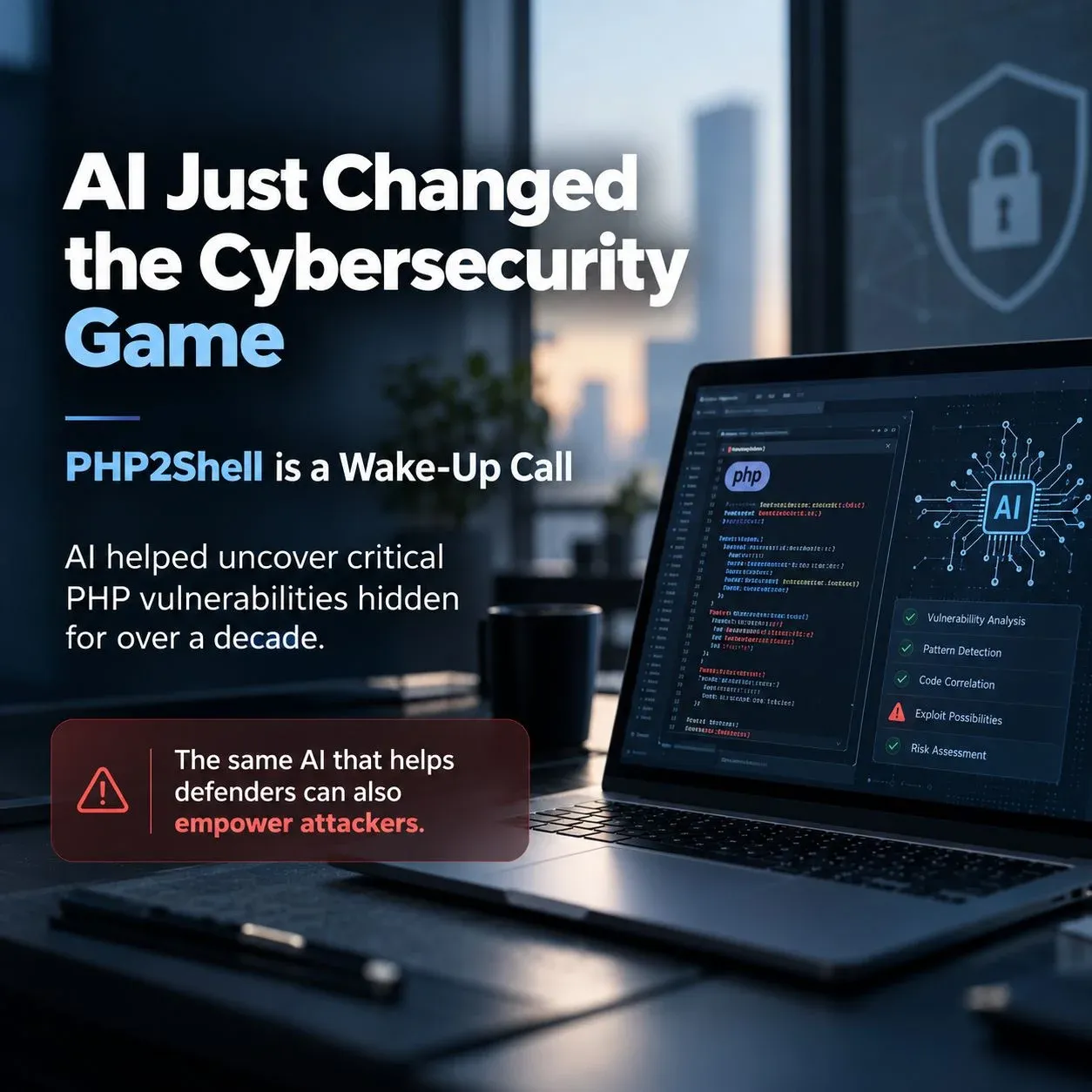
On October 21, 2026, the cybersecurity community witnessed a significant development that could reshape the future of software security.
Two critical vulnerabilities were publicly disclosed in PHP, one of the most widely used programming languages powering websites and web applications worldwide.
Both vulnerabilities received a CVSS v4.0 severity score of 9.2 out of 10.
What makes this discovery particularly interesting is that the underlying weaknesses had existed in PHP for more than a decade.
And advanced artificial intelligence played a major role in uncovering and demonstrating their impact.
The incident, now widely known as PHP2Shell, raises an important question:
If AI can uncover vulnerabilities that have remained hidden for years, what happens when the same capabilities become available to attackers?
1. What Actually Happened?
PHP is the foundation of a significant portion of the modern web.
Popular platforms such as WordPress, Drupal, Joomla, and Wikipedia’s MediaWiki depend on PHP.
According to Wiz Research, approximately 70% of websites use PHP.
On October 21, 2026, researchers disclosed two critical vulnerabilities:
- CVE-2026-109618: Remote code execution through out-of-memory handling and memory corruption.
- CVE-2026-109619: Remote code execution involving stale internal PHP state.
Both vulnerabilities involve how PHP manages memory and internal state when errors occur.
Under vulnerable conditions, attackers could potentially execute arbitrary code on affected servers without authentication.
In some scenarios, sensitive information such as authentication tokens, passwords, and API keys could also be exposed through process-memory disclosure.
The particularly concerning aspect is that these vulnerabilities exist within the PHP engine itself.
Even applications developed with secure coding practices could be exposed if they were running a vulnerable PHP environment.
This is why the discovery attracted significant attention across the technology industry.
Importantly, PHP’s widespread usage does not mean 70% of all websites were confirmed exploitable. Actual exposure depends on the PHP version, server configuration, and other technical conditions.
2. How AI Changed the Discovery Process
Traditional vulnerability research is highly specialized.
Researchers often spend weeks or months reviewing source code, analyzing memory behavior, testing assumptions, and developing reliable ways to demonstrate security weaknesses.
Complex memory-related vulnerabilities are particularly difficult to investigate because exploitation can depend on subtle differences in software versions, system configurations, and runtime behavior.
This is where AI made a remarkable difference.
Wiz Research reported using several advanced AI systems during its investigation:
- Google DeepMind’s Gemini 4 Argon
- OpenAI’s GPT-5.6 Sol
- Wiz Atlas
These tools supported different stages of the research, including vulnerability discovery, exploit development, testing, and patch validation.
Gemini 4 Argon was particularly important in the work described by Wiz.
Separately, researchers at Calif, using OpenAI’s technology, also identified critical weaknesses. OpenAI and Wiz contributed to the coordinated disclosure process, while the PHP maintainers led the development and release of security fixes.
This wasn’t simply a matter of asking an AI chatbot to find a vulnerability.
It involved combining advanced AI reasoning, security expertise, automated testing, and human validation.
AI did not eliminate the need for cybersecurity researchers. It significantly expanded what researchers could achieve.
And that is the real breakthrough.
3. Why This Discovery Is Different
Security vulnerabilities are nothing new.
Over the years, incidents such as Heartbleed and Log4Shell have demonstrated how weaknesses in widely used software components can affect organizations around the world.
PHP2Shell brings an additional dimension to the discussion.
The vulnerabilities were not necessarily impossible to discover through traditional methods. Rather, the complexity and effort required to develop working exploits represented a significant barrier.
AI helped reduce that barrier.
Researchers could analyze complicated code paths, test hypotheses, understand failures, and refine their approaches more efficiently.
Tasks that previously demanded extensive manual analysis became more practical.
This creates a major shift in cybersecurity.
Historically, some vulnerabilities were difficult to exploit because doing so required exceptional expertise and significant time.
AI is beginning to change that assumption.
A vulnerability that was once considered impractical to exploit may become a realistic threat as AI-assisted research tools improve.
Security can no longer depend on the assumption that a weakness is simply too complicated for attackers to exploit.
4. The Other Side of the Story: AI Can Empower Attackers Too
This is perhaps the most important lesson from PHP2Shell.
The same technology that assists ethical security researchers can also potentially assist malicious actors.
AI can help analyze source code, understand complex vulnerabilities, automate portions of security research, and adapt techniques to different environments.
For defenders, these capabilities present enormous opportunities.
For attackers, they can reduce some of the technical barriers traditionally associated with sophisticated cyberattacks.
However, we should distinguish potential capabilities from confirmed attacks.
In its October 27 follow-up, Wiz reported observing exploitation attempts but had not confirmed a successful end-to-end attack in its own telemetry. The researchers also noted evidence reported by others and emphasized that developing reliable exploits across different deployments remained challenging.
Nevertheless, the long-term direction is becoming clearer.
The advantage may increasingly belong to whoever can discover, understand, and address vulnerabilities faster.
This changes the dynamics of cybersecurity for both organizations and security professionals.
5. What This Means for Technology Leaders
For organizations operating large-scale applications, PHP2Shell highlights several important priorities.
First, software security must extend beyond application code.
Traditional security reviews often focus on business logic, authentication, APIs, and application-level vulnerabilities.
But security also depends on programming language runtimes, frameworks, third-party libraries, infrastructure, and deployment configurations.
A well-designed application cannot fully compensate for a critical vulnerability in its underlying runtime.
Second, patch management must become more proactive.
Organizations need a reliable inventory of software versions, clear ownership of infrastructure components, defined security-update procedures, and the ability to deploy emergency patches quickly.
For PHP2Shell, the PHP team released fixes on October 21, 2026, in versions 8.2.35, 8.3.36, 8.4.27, and 8.5.12.
Organizations running older releases must consult their vendors for supported backported fixes or upgrade to a supported PHP version.
The PHP security team has emphasized that temporary mitigations cannot fully replace the security updates.
Third, AI-assisted security needs to become part of the engineering process.
There is a strong opportunity to introduce AI-assisted capabilities into:
- Source code and dependency analysis
- Security testing and vulnerability discovery
- Threat detection and log analysis
- Vulnerability prioritization and patch validation
- Continuous security assessments throughout the software development lifecycle
These capabilities should complement established security tools and expert review, rather than replace them.
Finally, cybersecurity must become a continuous engineering responsibility, not just a periodic audit activity.
As AI accelerates the discovery of vulnerabilities, organizations will need to reduce the time between identifying a weakness and addressing it.
6. Are We Entering a New Era of AI-Driven Cybersecurity?
I believe PHP2Shell represents an important turning point.
For years, AI adoption in software engineering has largely focused on productivity: generating code, creating documentation, improving testing, and accelerating development.
Now we are witnessing its growing influence in a much more critical area: the security of the software infrastructure on which modern society depends.
The implications extend beyond PHP.
Similar approaches could potentially help researchers discover weaknesses in operating systems, databases, networking components, open-source libraries, and other foundational technologies.
That creates both an opportunity and a responsibility.
AI could help us discover and fix serious vulnerabilities much earlier.
At the same time, it could make sophisticated attacks more accessible.
The response should not be to avoid AI, but to invest in defensive capabilities, responsible security research, stronger software engineering practices, and coordinated vulnerability disclosure.
Final Thoughts
Did AI save the internet?
That would be an exaggeration.
What happened was more meaningful.
AI-assisted researchers helped uncover serious vulnerabilities, and a coordinated effort involving security researchers, open-source maintainers, technology companies, and infrastructure providers helped deliver protections before public disclosure.
It demonstrates what becomes possible when human expertise and advanced AI capabilities work together.
But it also reminds us that the cybersecurity landscape is evolving rapidly.
For technology professionals and organizational leaders, the challenge is no longer simply to build functional and scalable systems.
We must build systems that can continuously adapt to an increasingly complex threat environment.
The next generation of cybersecurity will not be defined only by how effectively we respond to attacks, but by how intelligently we discover and eliminate vulnerabilities before they are exploited.
And AI will play a major role in that future.